
Time-Based vs. Hours-Based Maintenance: Which Schedule Does Your Equipment Need?

Time-Based vs. Hours-Based Maintenance: Which Schedule Does Your Equipment Need?
One of the most common questions we hear from new boat owners is some version of: “How do I know when this is actually due?”
It’s a great question, and the answer isn’t always obvious. Some maintenance should happen on a calendar schedule—every six months, every year—regardless of how much you use your boat. Other maintenance depends entirely on how many hours your equipment has run. And some equipment needs both.
Understanding the difference is key to keeping your boat reliable without either over-maintaining (wasting time and money) or under-maintaining (risking failures). Let’s break it down.
Time-Based Maintenance
Time-based (or calendar-based) maintenance happens on a fixed schedule regardless of usage. The clock is always ticking, even when your boat is sitting at the dock or on the hard.
Why time matters:
Many things degrade simply with the passage of time, not use. Rubber components dry out and crack. Fuel and oil break down. Zinc anodes corrode whether you’re sailing or not. And safety equipment needs regular inspection to make sure it works when needed.
Examples of time-based maintenance:
- Testing EPIRB Beacons
- Servicing Lifejackets
- Servicing Liferafts
- Servicing fire extinguishers (annual inspection requirements)
- Replacing flares (expiration dates)
- Inspecting and replacing zinc anodes
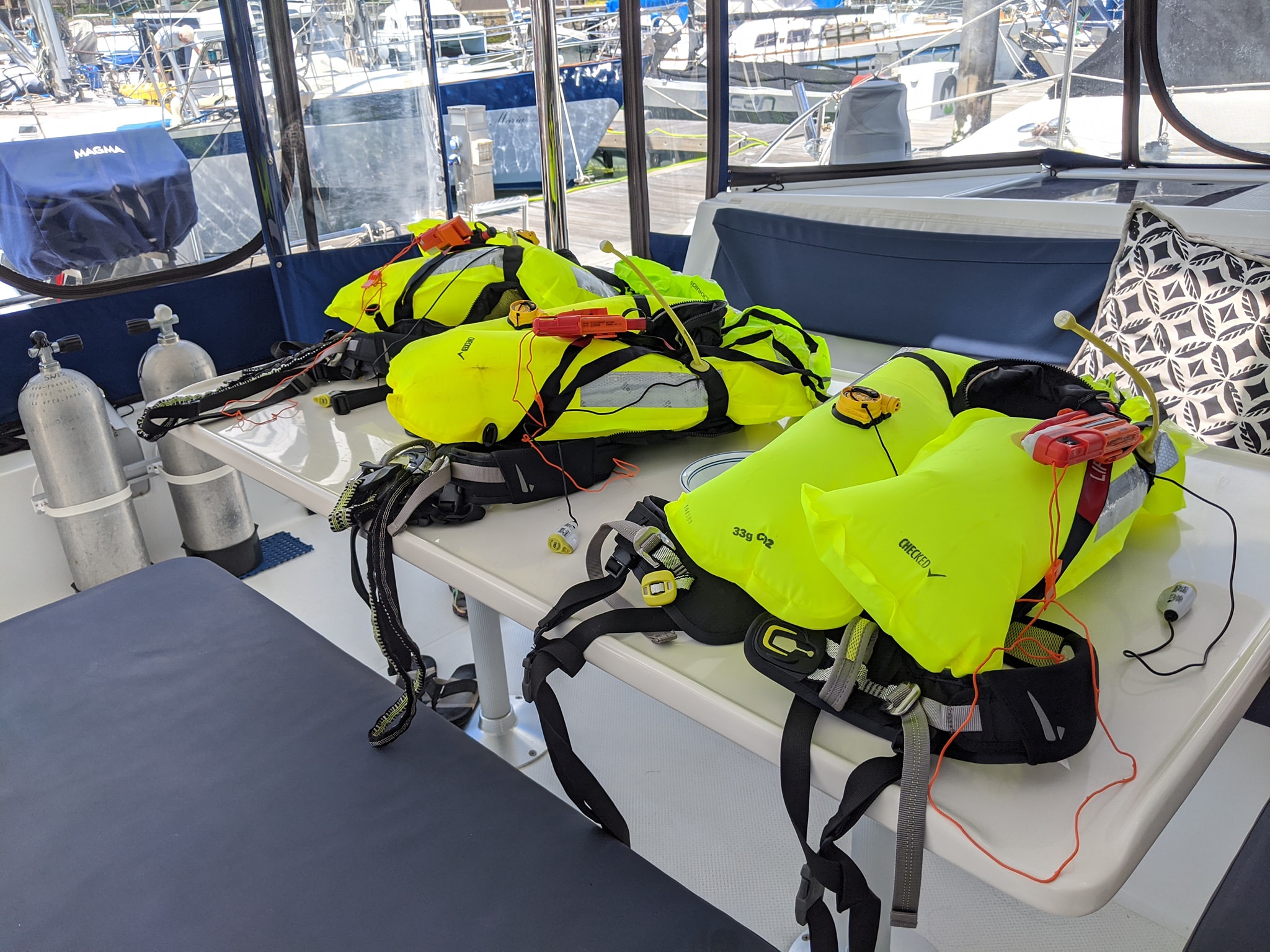
The key insight: A boat that’s used only a few weekends a year still needs much of this maintenance on schedule. “But I barely used it!” doesn’t apply when time is the enemy.
Hours-Based Maintenance
Hours-based (or usage-based) maintenance depends on how many hours your equipment has actually operated. This is most common for engines, generators, and other mechanical equipment that wears with use.
Why hours matter:
Mechanical wear accumulates with operation. The more hours your engine runs, the more its components wear, the more combustion byproducts build up, and the closer you get to needing service. A boat that motors long distances racks up hours quickly, while a daysailer might run the engine only briefly. Many initial servicing tasks are based solely on hours.
Examples of hours-based maintenance:
- Initial engine oil and filter changes (e.g., after first 50 hours)
- Changing transmission oil
- Valve adjustments
- Fuel injector service
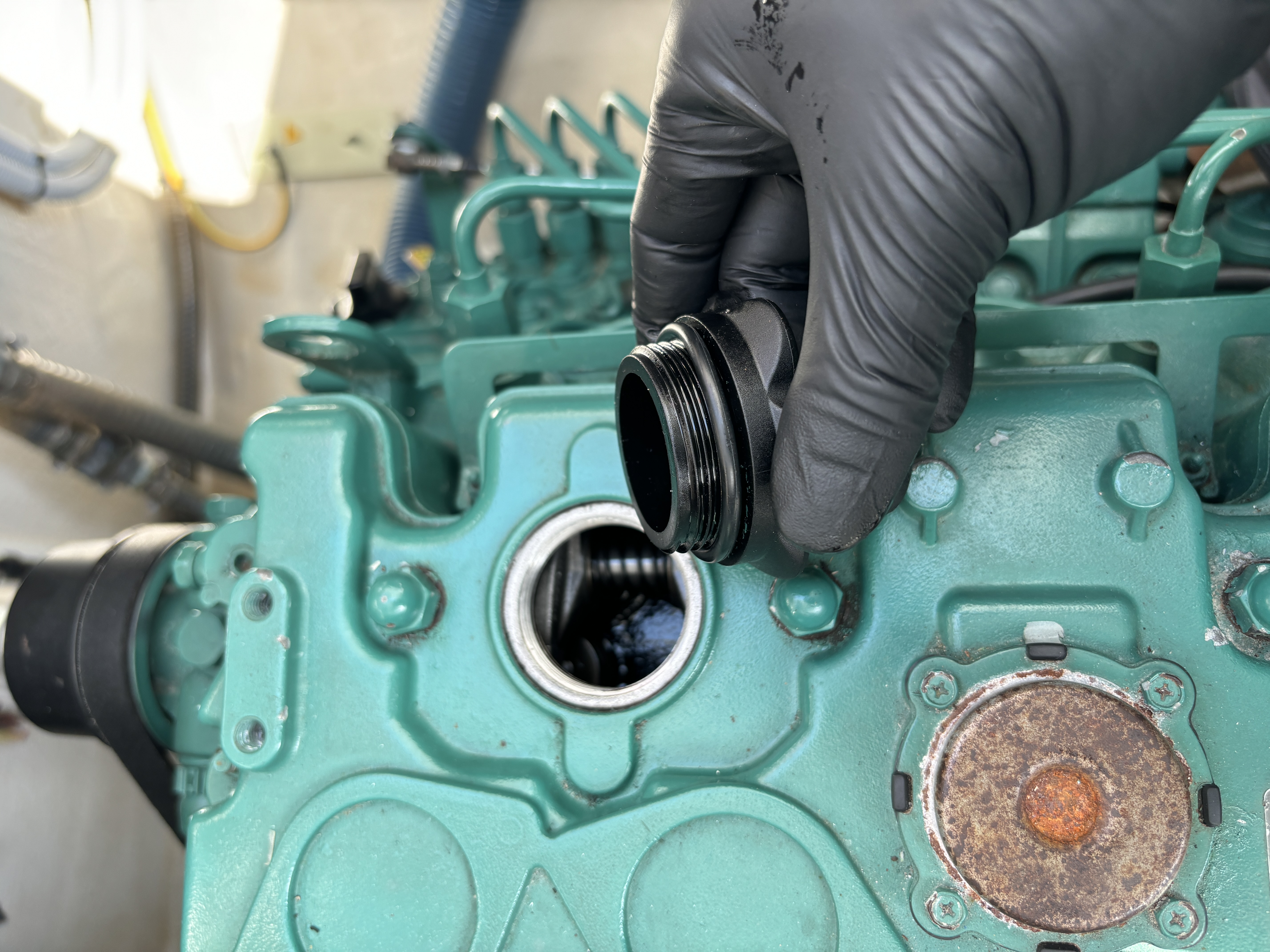
The key insight: Two identical boats can have wildly different maintenance needs based on usage. The cruiser putting 500 hours a year on their engine needs far more frequent service than the weekend sailor logging 30 hours.
When Both Apply (Whichever Comes First)
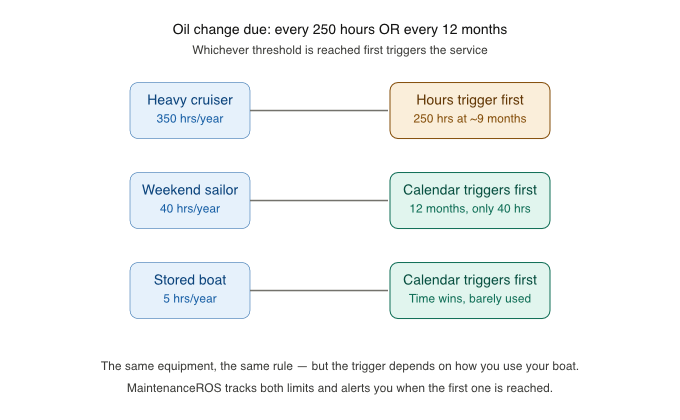
Here’s where it gets interesting: many equipment maintenance tasks use BOTH schedules, with maintenance due whenever the first threshold is reached.
Your engine manufacturer might recommend an oil change every 250 hours OR every 12 months, whichever comes first. This protects against both wear (hours) and degradation (time).
How to Figure Out What Your Equipment Needs
1. Check the manufacturer’s documentation This is always your best source. Owner’s manuals specify maintenance intervals, usually noting whether they’re time-based, hours-based, or “whichever comes first.” And note - different manufacturers of the same type of equipment can specify different types of intervals for the same task!
The good news: MaintenanceROS provides manufacturer recommended maintenance schedules AND digital manuals for 98% of equipment in our database, so this information is at your fingertips.
2. Consider your usage patterns Are you a high-hours cruiser or a low-hours weekend boater? This affects which schedule typically triggers first for your dual-requirement equipment.
3. Factor in your environment Boats in harsh environments (tropical heat, heavy salt exposure) may need more frequent maintenance than manuals suggest. Time-based intervals especially may need adjusting. You can adjust any MaintenanceROS schedule to fit your exact needs.
4. When in doubt, go conservative If you’re unsure, err on the side of more frequent maintenance. The cost of an extra oil change is far less than the cost of a damaged engine.
How MaintenanceROS Handles Both
This is exactly the kind of complexity MaintenanceROS was built to manage. When you add equipment to your account, the system can track:
- Time-based intervals that count down from the calendar
- Hours-based intervals that count down as you log operating hours
- Combined schedules that alert you when whichever threshold comes first is reached
Instead of trying to remember whether your oil change is due by date or by hours—and doing that math for every piece of equipment on your boat—MaintenanceROS does it for you. You log your engine hours, the system tracks the calendar automatically, and you get reminders when maintenance is actually due.
No more guessing. No more “I think it’s been about a year… or was it 80 hours?” Just clear, accurate maintenance scheduling based on how YOU use your boat.
The Bottom Line
Understanding the difference between time-based and hours-based maintenance helps you keep your boat reliable without wasting effort.
The key is matching your maintenance to your actual situation. A weekend sailor and a full-time cruiser have very different needs, even with identical boats.
Whatever your usage pattern, the goal is the same: stay ahead of maintenance so you spend more time enjoying your boat and less time dealing with preventable breakdowns.
Ready to take the guesswork out of maintenance scheduling?
Start your free 30-day trial and let MaintenanceROS track both your time-based and hours-based maintenance automatically.